Cart
0
A2 Origins Journal
Bilona Method Ghee: Full Production Process,Benefits & Buying Guide
On This Page
Bilona Method Ghee: Full Production Process, Benefits & Buying Guide
If you are shopping for bilona method ghee, you need to understand what goes into the entire production chain before choosing a product.
Traditional Bilona ghee is produced using the following process:
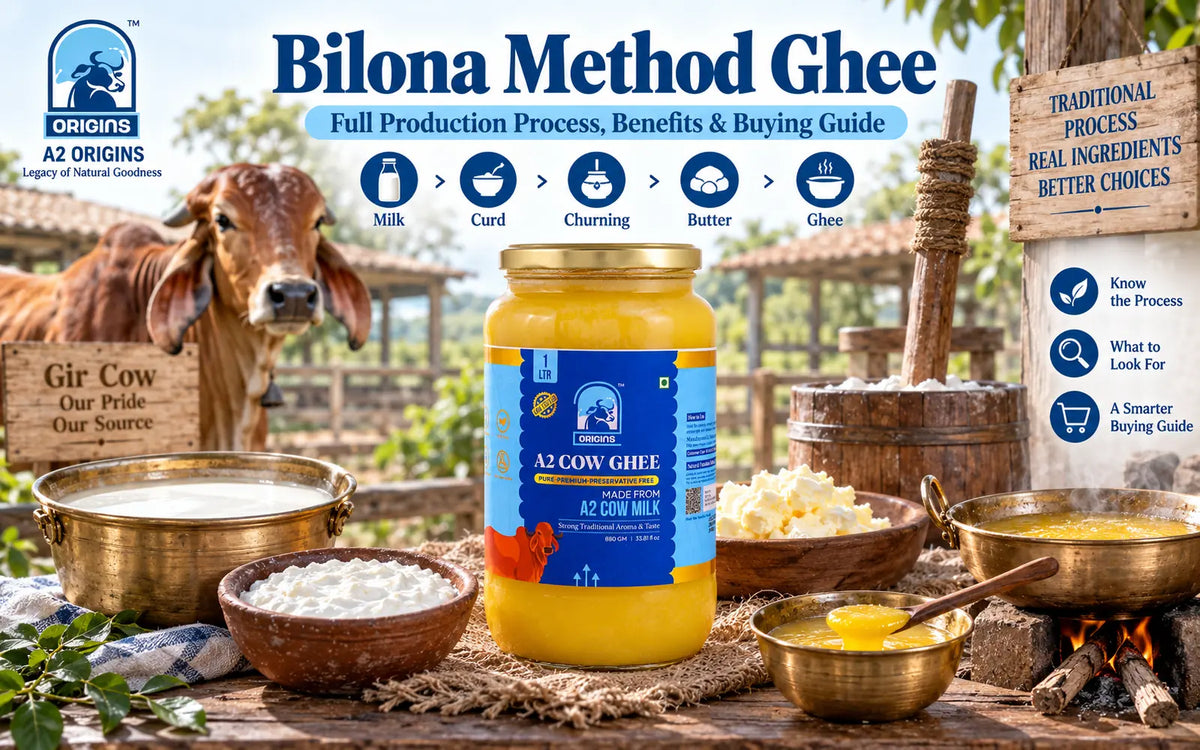
Fresh Cow Milk → Curd → Bilona Churning → Butter → Slow Heating → Ghee
Each step requires time and effort that makes it a bit expensive than other types of ghee.
In this guide, we will be explaining the entire process of bilona method ghee production with its benefits, what to look for and what to avoid while buying it.
What Is Bilona Method Ghee?
Bilona method ghee producers use the traditional way of ghee-making that uses curd as a base before proceeding to churning butter out of it.
The butter obtained is then heated at a slow rate until water is completely evaporated and milk solids get filtered out to achieve clarified fat known as ghee.
What makes traditional Bilona ghee different from other types is the fact that it does not start with separating cream from milk.
The process involves the following:
· Milk source
· Milk quality
· Curd formation
· Fermentation
· Churning
· Butter quality
· Heating
· Filtration
· Storage
Therefore, just having the word ‘Bilona’ written on a pack is not enough for you to understand the kind of ghee you are getting.
You need to look at how the brand actually makes the product.
How ghee Is Made Using the Bilona Method?
The traditional process involves multiple steps.
1. Fresh Cow Milk
The process of making ghee starts with obtaining fresh cow milk.
For A2 cow ghee , this becomes an important consideration if a brand is advertising that they are using Gir cow milk.
This should be the first question that you ask and find answers to since it sets the background for everything else that goes into preparing ghee.
2. Setting the Curd
The producers prepare the milk and allow it to set into curd.
Traditional Bilona uses this curd as a base for churning to extract butter.
Curd undergoes fermentation before being put through the churning process to make butter.
This is different from other traditional ghee-making processes that call for directly obtaining cream from milk.
3. Traditional Bilona Churning
After obtaining the curd, the producers make the butter from it using traditional Bilona churning.
The process calls for using a Bilona churner (usually made from wood) to churn the curd.
Butter is obtained from the curd in the form of a mixture with buttermilk.
Producers separate butter from the buttermilk and use it as the raw material for making ghee.
The quality of the curd and its subsequent fermentation and churning determine the quality of butter that will be obtained.
This further determines the quality of the ghee obtained at the end of the process.
4. Butter Separation
Butter is obtained from the curd in the form of a mixture with buttermilk.
The producers collect the butter separately as the raw material for making ghee.
The quality of the butter depends on the milk, curd preparation and the churning process.
Therefore, each of these earlier steps becomes of paramount importance for obtaining good-quality ghee.
5. Slow Heating
The producers slowly heat the collected butter to clarify it.
During this process, moisture is separated and milk solids are filtered out and separated from the fat.
Careful heating allows the producer to manage the final aroma, flavour, colour and texture of the ghee.
The heating process requires attention as over-heating can adversely affect the final ghee.
6. Filtration and Final Ghee
After clarification, the producers filter the ghee to remove any remaining milk solids.
They then cool and pack the ghee.
At this point, we have reached at the end of a long journey that is:
Milk → Curd → Churning → Butter → Slow Heating → Ghee
That journey is what constitutes traditional Bilona ghee making.
Now that you know how bilona method ghee is produced, let us look at why it is more expensive than some other ghee products.
Why Is Bilona Ghee More Expensive?
It is quite common to hear people say that bilona method ghee is expensive compared to regular packaged ghee.
The production process is one reason.
The traditional bilona process goes through multiple stages before reaching the final product.
Milk → Curd → Churning → Butter → Heating → Filtration
Each additional stage in the production of a product usually demands extra time, effort and handling.
The amount of milk required can also contribute to the final cost depending on factors such as milk fat content, breed, season and production efficiency.
Therefore, you cannot simply judge the quality of ghee on the basis of its final price tag alone.
There are also other factors that can help you determine which one is a better buy.
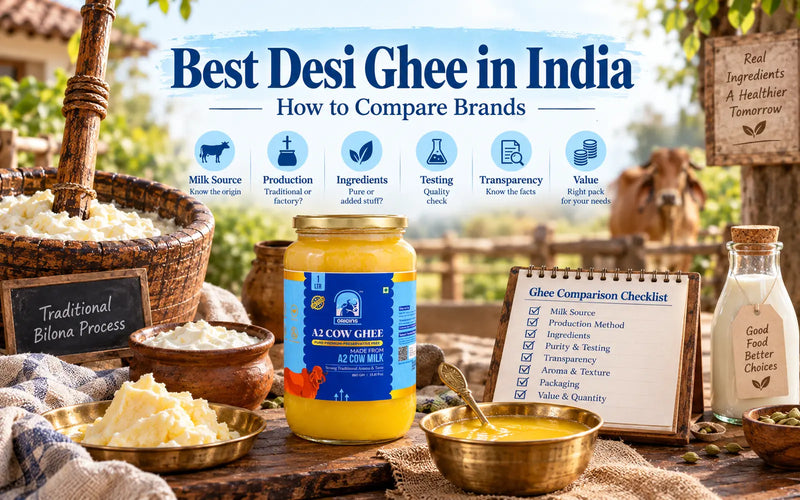
Before comparing prices, look at the following:
· Milk source
· Production method
· Ingredients
· Milk requirement
· Quality practices
· Testing information
· Packaging
· Quantity
· Brand transparency
A higher price does not necessarily mean higher quality.
The production process should back up the final price of a product.
Bilona Method Ghee vs Normal Ghee
One of the main differences between Bilona method ghee and normal ghee is the production process.
Traditional bilona method ghee uses a curd-first approach to obtain butter from curd.
The churning process separates butter from buttermilk.
Modern ghee producers can adopt a variety of manufacturing methods depending on the producer.
This does not mean that every modern ghee is of low quality or that every Bilona ghee is automatically better than the other.
Understanding the manufacturing process is a better approach to comparing the two.
Traditional Bilona Process
Milk → Curd → Churning → Butter → Slow Heating → Ghee
Other Ghee Production Methods
Different manufacturers can adopt a variety of processing methods.
Some might involve cream or other intermediate stages before clarification.
Therefore, it is always better to look at the product information rather than simply reading a name.
Is Bilona Ghee Healthier Than Regular Ghee?
This is a very important question with a very nuanced answer.
Bilona is a production method.
It does not necessarily mean that every Bilona ghee is automatically healthier than every regular ghee.
The final nutritional composition of ghee depends on factors such as the milk source, processing and product composition.
If a brand makes specific health claims, buyers should look for reliable evidence to support those claims.
As an everyday buyer, focus on the following:
· Milk source
· Production method
· Ingredients
Product quality
· Testing information
· Brand transparency
· Proper storage
Traditional production can be an important quality consideration, but it should not be treated as automatic proof of health benefits.
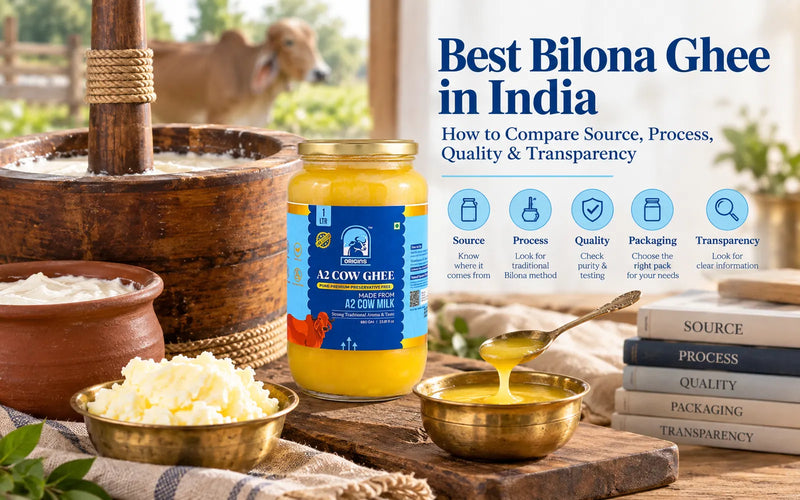
How to Identify Pure Bilona Ghee?
There is no one characteristic that can identify pure Bilona ghee.
Instead, look at the complete information about the product.
Check the Ingredients
The first thing that you should check is the ingredient list.
Look for transparency about what the product contains.
Check the Production Process
A genuine Bilona claim should have the process explained in detail.
Look for the journey from milk to curd, churning, butter and finally ghee.
If the brand provides no meaningful information about the process, it is best to ask questions before making a purchase.
Check the Milk Source
If a product claims to use Gir cow milk, check whether the brand explains its sourcing clearly.
Milk-source transparency gives buyers more confidence in the product.
Check Testing Information
Lab testing can be a good way to determine the quality and purity of a product.
If a brand provides a lab report, check the parameters that it actually covers.
Do not assume that the words “lab tested” prove every possible health or quality claim.
What Does Bilona Ghee Taste and Smell Like?
Traditionally prepared ghee can have a distinctive dairy aroma and flavour.
The final characteristics can vary depending on:
· Milk source
Curd fermentation
Churning process
· Butter quality
Heating technique
Colour can also vary.
Season, feed, milk composition and processing can influence the appearance of ghee.
Therefore, you should not judge purity only by colour.
A pleasant aroma and clean taste can be useful observations, but they cannot independently prove purity.
Can You Make Bilona Method Ghee at Home?
Yes, you can make bilona method ghee at home if you have suitable milk and enough time.
The basic process is:
Fresh Milk → Curd → Churning → Butter → Heating → Ghee
First, prepare the curd from the milk.
Then churn the curd to separate butter from buttermilk.
Collect the butter and slowly heat it until it clarifies into ghee.
The process requires more time and effort than making ghee from directly separated cream.
That is why many consumers prefer purchasing traditionally prepared Bilona ghee from a producer.
What Should You Check Before Buying Bilona Ghee Online?
Do not choose a product only because its packaging says “Bilona.”
Look at the complete information about the product.
1. Check the Milk Source
Understand what type of milk the brand uses.
If the product claims Gir cow milk, look for clear sourcing information.
2. Check the Production Process
See whether the brand explains the complete Bilona process.
Look for the traditional sequence:
Milk → Curd → Churning → Butter → Ghee
3. Check the Ingredients
Read the ingredient list carefully.
4. Check Testing Information
Look for available lab testing or quality information.
5. Check the Packaging
Good packaging helps protect ghee from moisture, contamination and unnecessary exposure.
6. Check Storage Instructions
Follow the manufacturer’s storage instructions after opening.
7. Check Brand Transparency
Look at how clearly the brand communicates its sourcing, manufacturing and quality practices.
Best Bilona Cow Ghee in India: How Should You Compare Brands?
There is no single factor that makes one Bilona ghee the best choice for every buyer.
Instead, compare brands using the same checklist.
Ask these questions:
Where does the milk come from?
How is the curd prepared?
Is the curd traditionally churned?
How is the butter separated?
How is the butter heated?
Does the brand provide testing information?
Are the ingredients clearly mentioned?
Is the packaging suitable for ghee?
This approach helps you compare products using actual information instead of relying only on advertising claims.
A2 Origins Bilona Method Ghee
A2 Origins focuses on the traditional Bilona journey from milk to ghee.
The process follows:
Gir cow milk → Curd → Bilona churning → Butter → Slow heating → Ghee
The brand also focuses on transparent product communication and lab-tested purity.
When choosing any Bilona ghee, the same principle applies.
Understand the production process first, then evaluate the milk source, quality information, testing and overall transparency.
Common Mistakes When Buying Bilona Ghee
Many buyers make similar mistakes when comparing ghee products.
Mistake 1: Choosing Only by Price
The cheapest product does not always offer the best value.
Compare the complete production process and product information before comparing prices.
Mistake 2: Trusting the Word “Bilona” Alone
The word “Bilona” should encourage you to investigate the actual manufacturing process.
Read the product description carefully.
Mistake 3: Assuming Colour Proves Purity
Colour alone cannot confirm purity.
Several natural factors can affect ghee colour.
Look at the complete product information instead.
Mistake 4: Believing Every Health Claim
Do not accept every health claim without checking the evidence behind it.
Traditional practices and scientifically established benefits are not always the same thing.
Mistake 5: Ignoring the Milk Source
The milk source forms an important part of understanding the product.
If a brand makes a specific milk-source claim, check whether it provides useful information about that claim.
Final Takeaway
Bilona method ghee is based on a traditional production journey that starts with milk and moves through curd, churning, butter and slow heating.
The process involves more than simply looking at the final jar.
If you want to choose a good Bilona ghee, look beyond the front label.
Check the milk source, production method, ingredients, testing information, packaging and brand transparency.
A product becomes easier to evaluate when the brand clearly explains what happens from the first stage of milk preparation to the final ghee.
The goal should not be to choose a product because of one attractive claim.
Instead, understand the complete process and make your decision based on transparent information.
Frequently Asked Questions
What is the Bilona method of making ghee?
The traditional Bilona method follows the process of milk → curd → churning → butter → slow heating → ghee.
How much milk is required for 1 kg ghee through the Bilona method?
The quantity can vary depending on milk fat content, breed, season and production efficiency. The exact requirement is not the same for every producer.
Is Bilona ghee healthier than regular ghee?
Bilona describes a production method. It does not automatically prove that the final ghee is healthier than every regular ghee.
How can I identify pure Bilona ghee?
Check the milk source, production process, ingredients, testing information and brand transparency. Colour and aroma alone cannot prove purity.
What is the difference between Bilona method ghee and normal ghee?
Traditional Bilona ghee uses curd as the starting point for churning and butter separation before clarification. Other ghee production methods can follow different processing routes.
Why is Bilona ghee more expensive?
The traditional process involves multiple stages, additional time, labour and handling. Milk requirements can also vary depending on milk composition and production efficiency.
What should I check before buying Bilona ghee online?
Check the milk source, production method, ingredients, testing information, packaging, storage instructions and overall brand transparency.
Can Bilona method ghee be made at home?
Yes. You can prepare it by setting curd from milk, churning the curd to separate butter and slowly heating the butter to make ghee.
What is the Bilona ghee price for 1 kg?
The price varies between brands depending on milk source, production method, milk requirement, processing, packaging and other costs. Compare the complete product details rather than price alone.
Is Bilona method ghee available online?
Yes, Bilona ghee is available through various online sellers and brand websites. Before purchasing, check the production method and product information carefully.