Cart
0
A2 Origins Journal
Indian Gir Cow Bilona Desi Ghee: What It Costs and How to Buy It Right
On This Page
Bilona Desi Ghee: What It Costs and How to Buy It Right
Two jars sit side by side. One costs about ₹700. The other costs about ₹2,300. Both say "desi ghee." What are you paying for?
The answer is one word: bilona. Bilona desi ghee is made from curd, not cream, and that changes the work, the price and the aroma. This guide shows how it's made, what it costs in 2026, and how to buy a real jar.
What Is Bilona Desi Ghee?
Bilona desi ghee is desi ghee made the curd-first way. Milk becomes curd, a wooden churner called a bilona turns the curd into butter, and slow heat turns that butter into ghee.
Regular ghee usually skips the curd. Makers separate cream from milk and heat it directly. That shortcut is faster and cheaper.
What Does "Desi" Mean on a Ghee Label?
Not much, legally. Brands use "desi" for indigenous cow milk, for buffalo ghee, or simply for homestyle ghee. Anveshan, for example, sells a bilona-churned buffalo ghee inside its desi ghee range.
Authentic Urban's label guide notes that "desi" names no breed and no method unless the page does. So check the animal, the breed and the method.
How Is Bilona Desi Ghee Made?
It takes about two days and five steps.
1. Boil and cool. Fresh milk is heated, then cooled until lukewarm.
2. Set the curd. A spoon of culture turns the milk into curd overnight.
3. Churn by hand. A wooden bilona beats the curd until white butter (makkhan) floats.
4. Lift the butter. The leftover buttermilk becomes chaas.
5. Cook slowly. Low heat drives out the water. The solids turn golden, then get strained.
The milk bill is huge. Organic Gyaan and Ratnaya Organics cite 25 to 30 litres of milk per litre of ghee. Authentic Urban reports 30 to 35 litres of Gir cow milk per kilo.
Bilona Desi Ghee vs Regular Ghee
This table shows the practical differences between the two.
|
Feature |
Bilona desi ghee |
Regular cream ghee |
|
Starting point |
Milk set into curd |
Cream separated from milk |
|
Churning |
Curd churned by hand with a wooden bilona |
Cream often processed by machine |
|
Aroma |
Deeper and nuttier |
Milder and more uniform |
|
Fatty acid profile |
Same as cream ghee in one 2025 study |
Same as curd ghee in that study |
|
Time and milk |
About two days; 25 to 35 litres per kilo |
A few hours; far less milk |
|
Best use |
Eaten directly on roti, dal or khichdi |
Frying and bulk cooking |
How Much Does Bilona Desi Ghee Cost in 2026?
Expect roughly ₹1,950 to ₹2,400 for one litre of bilona cow ghee. Buffalo versions cost less. Regular cow ghee without a curd claim sits far lower.
We checked listed one-litre prices on brand pages on 30 September 2026. Treat them as ranges.
|
Ghee type (1 litre) |
Listed price |
Why it costs this much |
|
Bilona cow ghee (A2, desi or Gir) |
About ₹1,950 to ₹2,400 |
Most milk per kilo, indigenous cows, small batches |
|
Bilona buffalo ghee |
About ₹1,620 to ₹1,650 |
Buffalo milk is richer in fat, so it yields more ghee |
|
Regular cow ghee, no curd claim |
Median about ₹720 |
Cream route needs less milk and less labour |
The regular-ghee figure comes from Authentic Urban's September 2026 price index. Price alone won't prove quality. But a bilona cow jar far below this range should make you ask what milk went in.
Is Bilona Desi Ghee Healthier?
It tastes different, but a healthier profile isn't proven. A 2025 study in Food Chemistry: X made ghee from curd, cream and soured cream. Fatty acids stayed the same across all three. Aroma compounds did not.
Curd and soured-cream ghee carried more lactones and ketones, which shape flavour. Breed shifted fatty acids more than method.
Skip any brand that promises cures. Ghee is a calorie-dense fat, so ask your doctor if you have a health condition.
Common Mistakes When Buying Bilona Desi Ghee
• Trusting "bilona" or "desi" alone. Neither word is an official grade.
• Confusing A2 with bilona. A2 describes the cow's milk. Bilona describes the method.
• Judging by grain alone. Warm weather can keep real ghee soft or liquid.
• Chasing discounts. A steep cut on a bilona cow jar deserves a second look at the milk.
• Believing miracle claims. No jar of ghee cures disease.
What Actually Works: A Simple Buying Checklist
Ask the seller one question: how is this ghee made? A real maker says "curd" straight away. Then run this list.
• Method: the seller confirms milk is set into curd, then churned into butter.
• Milk: the page names the animal and breed, such as Gir cow.
• Proof: recent lab reports, or a batch you can see.
• Label: an FSSAI licence number that checks out online.
• Smell: a warm spoon smells of toasted milk, not flat butter.
• Price: high enough to cover many litres of milk per kilo.
Lab reports show purity, not method. So pair them with the seller's answers.
How to Use and Store Bilona Desi Ghee
Use it where you can taste it: hot roti, dal, khichdi and sweets.
Keep the jar airtight, away from sunlight, and use a dry spoon. Water spoils ghee. Follow the best-before date on your jar.
Why A2 Origins Bilona Desi Ghee
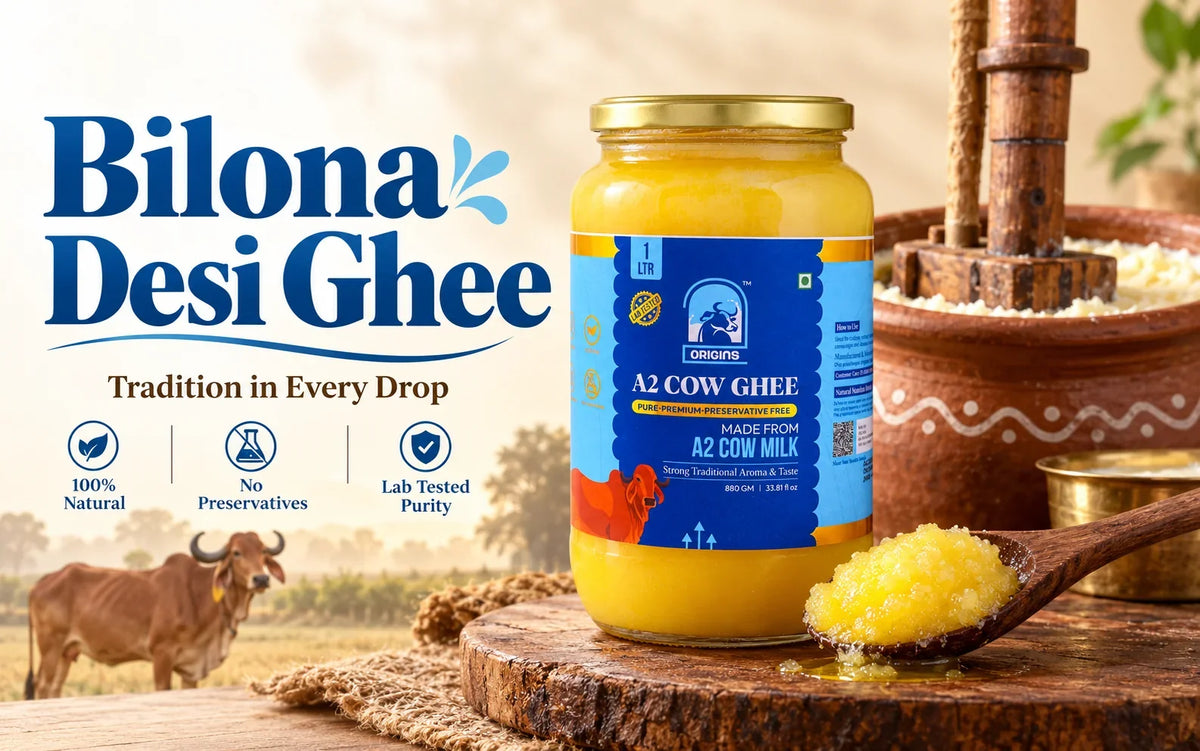
A2 Origins makes its A2 Gir Cow Bilona Ghee the curd-first way. Per the brand, the milk is heated in a clay pot and set with a curd culture. A wooden bilona churns it, and the butter is slow-cooked, filtered and packed.
The brand lists FSSAI certification and NABL-accredited lab testing. Measure it against the checklist above. On 30 September 2026, the 200 ml, 500 ml and 1 litre jars were listed at ₹549, ₹1,099 and ₹2,099.
Final Thoughts on Bilona Desi Ghee
Bilona desi ghee is worth buying if you value aroma and tradition, and can verify the method. Ask how it's made, check the milk and the licence, and compare the price with the ranges above.
Want more? Read the A2 Ghee Knowledge Hub or meet the team behind A2 Origins.
Frequently Asked Questions
What is bilona desi ghee?
It is desi ghee made from curd instead of cream. The curd is churned into butter with a wooden bilona, and the butter is slow-cooked. The method mainly changes aroma, cost and time.
Is bilona desi ghee the same as A2 ghee?
No. Bilona names the method. A2 names the type of beta-casein protein in the cow's milk. A jar can be one, the other, or both, and each claim needs its own proof.
Why is bilona desi ghee so expensive?
It needs roughly 25 to 35 litres of milk per kilo and about two days of work. Cream ghee needs far less of both.
How can I check if bilona desi ghee is pure?
Start with the FSSAI licence and lab reports. FSSAI requires ghee to have at least 99.5% milk fat and at most 0.5% moisture. Then ask about the method and milk, since lab reports can't prove churning.
Can lactose-intolerant people eat bilona desi ghee?
Usually only traces of lactose remain, because ghee is almost pure fat. That is true for any properly made ghee. A milk allergy is different, so check with your doctor first.
How much bilona desi ghee should I eat daily?
Several brands suggest 1 to 2 teaspoons a day. Ghee is calorie-dense, so keep portions modest.
How long does bilona desi ghee last?
Makers commonly quote 9 to 12 months sealed. Store it airtight, away from sunlight, and follow the best-before date on your jar.