Cart
0
A2 Origins Journal
Which Is The Best Ghee for Babies? A Parent's Guide

On This Page
Which Is The Best Ghee for Babies? A Parent's Guide
If you're wondering which ghee is best for babies, the short answer most pediatricians and traditional sources agree on is: pure, unflavoured A2 cow ghee, made from named indigenous breeds like Gir or Kankrej, introduced only after your baby turns 6 months old and started in tiny amounts. This isn't medical advice for your specific child — always confirm timing and quantity with your pediatrician first — but here's what actually goes into that recommendation, and what to watch out for.
A note before we go further: this article is general information, not a substitute for professional medical guidance. Every baby is different, and a pediatrician who knows your child's health history is the right person to make the final call.
Why Parents Ask "Which Is The Best Ghee for Babies?
" in the First Place
Ghee has been part of Indian weaning diets for generations, long before anyone talked about "fat-soluble vitamins" or "essential fatty acids." Grandmothers added a spoonful to rice and dal not because of a nutrition label, but because it worked — babies ate better, digestion seemed smoother, and it just felt like the right thing to do.
Modern nutrition science backs up a lot of that instinct, but it also adds nuance the old advice didn't have — which is really the point of this guide.
Which Type of Ghee Is Actually Best for Babies?
Not all ghee is the same, and figuring out the best ghee for babies means looking past the packaging, not just picking whatever jar says "pure" on the front.
A2 ghee vs. regular ghee. Most commercial ghee comes from cross-bred cows producing a mix of A1 and A2 beta-casein protein. A2 ghee comes only from native Indian breeds — Gir, Kankrej, Sahiwal, and a few others — and skips the A1 protein that some babies' developing digestive systems handle less smoothly. This is the main reason you'll see A2 ghee recommended over generic "cow ghee" for infants specifically.
Bilona-method vs. machine-made. Traditional bilona ghee — made by curdling milk, hand-churning it into butter, then slow-cooking it — keeps more of the natural nutrient profile intact than fast, machine-separated ghee. For a food you're feeding in tiny amounts to a baby, that difference in nutrient density actually matters more than it would for an adult eating larger quantities.
Plain, not flavoured. Skip anything with added salt, sugar, herbs, or "masala" blends. A baby's palate and digestive system don't need seasoning, and introducing multiple new ingredients at once makes it harder to spot a reaction if one happens.
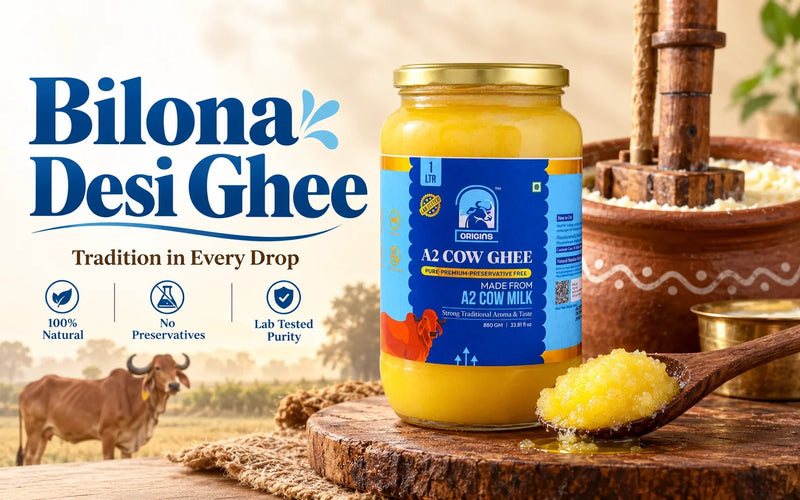
Named breed over vague labels. If a ghee jar just says "pure desi ghee" without naming which cow breed it came from, treat that as a reason to look closer, not necessarily a dealbreaker. Brands that name their breed — A2 Origins uses milk from Gir and Kankrej cows specifically — are usually more careful about the rest of their process too.
When to Introduce Ghee to a Baby's Diet
The consistent answer across pediatric guidance is after 6 months, alongside the start of solid foods (weaning), not before. Before 6 months, breast milk or formula already provides the fat and nutrients a baby needs, and their digestive system isn't ready for additional fats yet.
Once solids begin, ghee is usually introduced gradually, mixed into foods your baby is already eating — a little in mashed rice, dal, khichdi, or vegetable purée — rather than given on its own.
How Much Ghee for a Baby, and How to Add It
This is the part where general guidance has to stay general — exact amounts should come from your pediatrician, especially if your baby has any health condition. That said, here's the range you'll see consistently recommended as a starting point:
|
Age |
Typical Starting Amount |
How Parents Usually Use It |
|
6–8 months |
A few drops to about 1/4 teaspoon |
Mixed into mashed rice, dal, or vegetable purée |
|
8–12 months |
1/4 to 1/2 teaspoon |
Mixed into khichdi, porridge, or soft finger foods |
|
12+ months |
Up to about 1 teaspoon, per pediatrician guidance |
Cooked into regular family meals in moderation |
Treat this table as a general starting reference, not a prescription — confirm the right amount for your baby with your pediatrician, particularly if they have any digestive, liver, or growth concerns.
A few practical tips that make the introduction smoother:
• Start with a very small amount and watch for a couple of days before increasing it, the way you would with any new food.
• Stir it into food that's already warm rather than actively cooking with it at high heat, to preserve more of the nutrients.
• Keep a simple food diary during the first few weeks of introducing new foods, so it's easy to trace back if something doesn't agree with your baby.
Health Benefits Parents Usually Ask About
• Brain development. A baby's brain grows rapidly in the first two years, and a large share of that growth depends on dietary fat. Ghee's essential fatty acids contribute to that, though it's one part of an overall balanced diet, not a standalone brain food.
• Digestion. Ghee contains butyric acid, a short-chain fatty acid that supports the gut lining and is often mentioned in the context of easing occasional constipation in babies who are already eating solids.
• Fat-soluble vitamins. Vitamins A, D, E and K need dietary fat to be absorbed properly, and ghee is a natural carrier for them.
• Energy density. For babies who need extra calories in a small volume of food — including some babies who are gaining weight slowly — a pediatrician may specifically recommend adding ghee for that reason.
When to Be Extra Careful
A few situations call for talking to a pediatrician before adding ghee at all, rather than just starting cautiously:
• Suspected or confirmed cow's milk protein allergy (CMPA). Well-clarified ghee has very little casein left in it, but trace amounts can remain, and a baby with confirmed CMPA should only have it under medical supervision, or use an alternative like coconut oil instead.
• Any diagnosed liver or fat-absorption condition. These affect how a baby processes dietary fat generally, and ghee is no exception — this needs a doctor's guidance, not general advice from an article.
• Slow weight gain or rapid weight gain. Both directions are worth mentioning to your pediatrician, since ghee is calorie-dense and portion guidance may need to be adjusted either way.
None of this means ghee is risky for most babies — it's a well-tolerated, traditional weaning food for the vast majority of children. It just means the handful of exceptions are worth ruling out with your pediatrician rather than guessing.
Mistakes Parents Make When Choosing Ghee for Babies
A few patterns come up again and again when parents are shopping for the best ghee for babies, and most of them are easy to avoid once you know what to look for.
Assuming "cow ghee" automatically means A2 ghee. It doesn't. Plenty of ghee on store shelves comes from mixed or cross-bred cow milk, and unless the label specifically names an indigenous breed or says A2, it's probably not what you're looking for.
Starting with flavoured or "enriched" ghee. Some brands market ghee blended with herbs, ginger, or other additions as a baby product. Skip these for the first several months — plain ghee lets you introduce one new thing at a time, which matters if you ever need to figure out what caused a reaction.
Going by price alone. A higher price doesn't automatically mean better ghee for babies, and a lower price doesn't automatically mean lower quality either. What actually matters is whether the brand names its cow breed, describes a real bilona process, and is transparent about sourcing — check those details instead of just comparing rupees per litre.
Skipping the pediatrician conversation because "everyone gives their baby ghee." Tradition is a reasonable starting point, but every baby's health history is different, and a two-minute conversation with your pediatrician before you start is worth far more than a well-meaning relative's advice.
Storing and Preparing Ghee for Babies
A few practical habits make feeding ghee to babies easier and safer, and they're worth setting up before you start rather than figuring out as you go.
Keep a small, separate jar just for baby's ghee, and always use a clean, dry spoon to scoop it — introducing moisture or food residue into the jar can shorten its shelf life and, more importantly, isn't something you want near a baby's food. Store it away from direct sunlight and heat, the same way you would for the ghee your family already uses.
When you're mixing ghee into your baby's food, add it after cooking rather than frying with it at high heat — this keeps more of the nutrients intact and avoids overheating a small amount of fat, which can happen faster than you'd expect in a small serving. A gentle stir into warm (not hot) rice, dal, or purée is usually all it takes.
If you're traveling or your baby is with a caregiver, write the amount down clearly rather than relying on someone eyeballing "a little ghee" — a quarter teaspoon looks different to different people, and consistency matters more than precision at this stage.
Frequently Asked Questions
Is ghee safe for babies?
Yes, for most babies above 6 months, plain A2 ghee introduced gradually is considered safe and is a traditional part of Indian weaning diets. Always check with your pediatrician first, especially if your baby has any existing health condition.
Which ghee is best for babies, A2 or regular?
A2 ghee, made from breeds like Gir or Kankrej, is generally recommended over regular ghee for babies because it skips the A1 protein found in milk from cross-bred cows, which some babies digest less easily.
Can I give my 6-month-old ghee every day?
In small, consistent amounts mixed into regular meals, yes — many pediatricians are comfortable with daily use once a baby has tolerated it well for a few days. The amount should stay small and age-appropriate; ask your pediatrician for a number specific to your baby.
Does ghee help babies gain weight?
It can, since it's calorie-dense and easy to add to foods a baby already eats — this is part of why pediatricians sometimes recommend it for babies who need extra calories. It's not a substitute for addressing an underlying cause of slow weight gain, though, so that should still go through your pediatrician.
What's the difference between Gir cow ghee and regular A2 ghee for babies?
Gir is one specific A2 milk breed; "A2 ghee" more broadly can come from Gir, Kankrej, Sahiwal, or other native breeds. All of them share the same core A2 protein advantage — the breed name mostly tells you about traceability and sourcing, not a meaningfully different safety profile for babies.
The Bottom Line
For most babies past 6 months, plain, bilona-made A2 ghee — from a named breed like Gir or Kankrej — is a genuinely good addition to a weaning diet, started small and increased gradually. A2 Origins makes exactly this kind of ghee, from Gir and Kankrej cow milk using the traditional bilona method: see the A2 Origins Gir Cow Bilona Ghee, 1 Litre. But the single most useful thing in this whole guide is the least exciting one: talk to your pediatrician before you start, and let them make the final call for your child.