Cart
0
A2 Origins Journal
How to Identify Best Quality Ghee ? 7 Think Checks Before You Buy
On This Page
Best Quality Ghee: 7 Checks Before You Buy
Every jar says "pure." Very few say how the ghee was made, from which animal, or when.
That gap is where most bad buys happen. This guide shows what the best quality ghee looks like on paper, on the shelf and in your kitchen, so you can judge any jar in two minutes.
What Makes the Best Quality Ghee?
The best quality ghee has four things: real milk fat only, a named milk source, a clear method, and a recent pack date. It should also pass the FSSAI limits, which every legal ghee in India must meet.
Price and packaging don't prove any of these. A label does, if you know how to read it.
The FSSAI Limits Behind Every Best Quality Ghee
This table lists the tests FSSAI sets for ghee, and what each one catches.
|
Test |
FSSAI limit |
What it catches |
|
Milk fat |
At least 99.5% |
Diluted or blended fat |
|
Moisture |
At most 0.5% |
Water that makes ghee spoil |
|
Free fatty acids |
At most 2.0% |
Old or rancid ghee |
|
Baudouin test |
Negative |
Sesame oil mixed in |
|
β-sitosterol |
Absent |
Vegetable oil or vanaspati |
Passing all five proves purity, not quality. A plain dairy tin can pass. So can a farm jar. The checks below separate the two.
7 Checks for the Best Quality Ghee
1. Read the ingredients. One line, milk fat or butter, and nothing else.
2. Find the animal. "Pure" and "desi" don't name cow or buffalo.
3. Find the method. Bilona means curd was churned into butter, not cream.
4. Check the pack date. Ghee keeps well, but old stock has lost freshness.
5. Look at the jar. Glass, ideally dark, protects ghee from oxidation.
6. Verify the FSSAI licence number on the FoSCoS website.
7. Ask for the batch lab report, and compare it with the table above.
One taster who compared eleven brands found the best-by date a useful clue. Some jars had months of shelf life left, others only one.
Cow Ghee vs Buffalo Ghee: Which Is Better Quality?
Neither wins outright for best quality ghee. They suit different jobs, and a good label tells you which one you're buying.
|
Feature |
Cow ghee |
Buffalo ghee |
|
Colour |
Golden yellow |
Whitish to dull yellow |
|
Milk fat in the milk |
Lower, so less ghee per litre |
About twice as high |
|
Texture |
Lighter, often grainy |
Richer, sets firmer |
|
Best use |
Roti, dal, rice, the daily spoon |
Sweets, halwa, parathas |
What Science Says About the Best Quality Ghee
A 2025 study in Food Chemistry: X made ghee three ways: from curd butter, cream butter and soured cream butter. The making method did not change fatty acids. It did change aroma compounds, which shape flavour.
The cow's breed shifted fatty acids more than the method did. So the best quality ghee shows up as taste and sourcing. It has not been shown to be a health cure.
Common Mistakes When Buying Quality Ghee
• Trusting "pure" or "desi" alone. Neither names the animal or method.
• Judging by grain or colour. Season changes both, so they prove little.
• Starting with flavoured ghee. Spices change the taste of your dish.
• Ignoring pack dates. A shelf jar can be months old.
• Believing miracle claims. Ghee is a calorie-dense fat, not a medicine.
What Actually Works: The Price-per-Litre Test
To price the best quality ghee, divide the cost by the pack size in ml, then multiply by 1,000. Compare it with these tiers, based on brand pages checked in September 2026.
|
Tier (1 litre) |
Typical price |
What you are paying for |
|
Everyday dairy ghee |
₹705 to ₹810 |
Cream route, big batches, no named breed |
|
Named-breed curd ghee |
₹2,200 to ₹2,500 |
Gir breed named, curd method, batch report |
|
Premium and rare breed |
₹2,879 to ₹3,700 |
Own farms, rare breeds, small batches |
The milk maths explains the gap. Makers quote 30 to 35 litres of Gir milk for a kilo of curd-made cow ghee. A curd-made jar priced like a dairy tin should make you ask questions.
A2 Origins: Best Quality Ghee You Can Verify
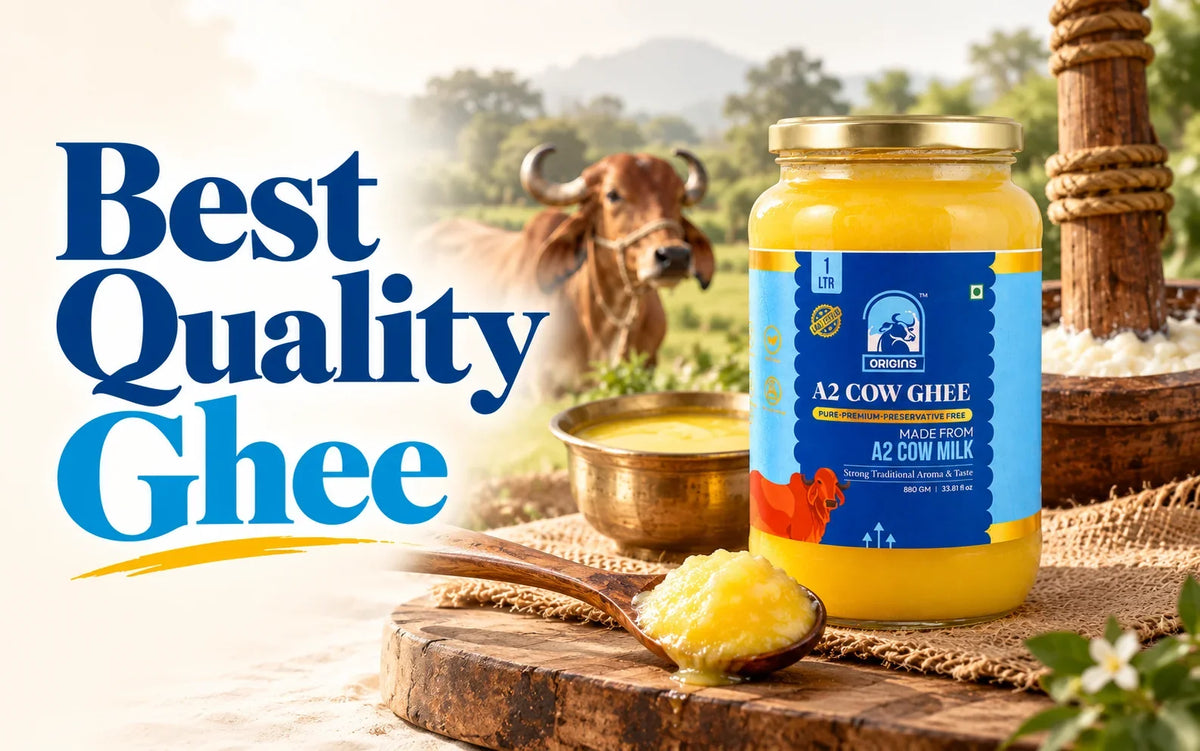
A2 Origins makes its A2 Gir Cow Bilona Ghee from curd. The milk is heated in a clay pot and set with a culture. A wooden bilona churns it, and the butter is slow-cooked, filtered and packed.
The brand lists FSSAI licence 20726022000610 and NABL-accredited lab testing, so you can run checks six and seven yourself. On 30 September 2026, the 200 ml, 500 ml and 1 litre jars were listed at ₹549, ₹1,099 and ₹2,099.
Final Thoughts on the Best Quality Ghee
The best quality ghee is easy to spot once you know the signs: one ingredient, a named animal, a clear method, a recent date and papers you can check. Use the seven checks, run the price test, and buy the jar that passes.
For more, read the A2 Ghee Knowledge Hub or meet the team behind A2 Origins.
Frequently Asked Questions
What is the best quality ghee?
The best quality ghee is made from milk fat alone, from a named animal, by a stated method, with a recent pack date. It should meet FSSAI limits and come with a licence number and batch report.
How can I check ghee quality at home?
Warm a spoonful. Good ghee melts clear and golden and smells of toasted milk. A waxy, flat or burnt smell is a warning. Home checks catch stale jars, but they can't prove breed or method.
Is cow ghee better than buffalo ghee?
Not always. Cow ghee is lighter and golden, and suits daily eating. Buffalo ghee is richer and firmer, and suits sweets. Quality depends on the maker, not the animal.
Is A2 ghee better quality?
A2 names the breed of the cow. Ghee is almost pure fat, so very little protein remains either way. Buy A2 for the sourcing and taste, and ask for proof of the breed.
Does ghee need to be refrigerated?
Usually not. Store it in a cool, dark place with the lid shut, and use a dry spoon. Follow the storage note on your jar.
How long does good ghee last?
Store-bought ghee can last up to a year when sealed. Once open, use it within a few months and watch for off smells or color changes.